Tuesday, 20 May 2014

Japanese Cuisine


  • Here's a little bit of historical art that will probably make your mouth water:
  • Rice was first introduced to Japan in 400 BC by Koreans that traveled. Rice then became essential for making paper, wine fuel and other materials. Tea and chopsticks were later introduced to Japan by Chinese tradesmen. 
  • Since the main religion in Japan was Buddhism, in the 500's; hardly anyone ever ate meat, leaving fish as a substitute source for protein. 
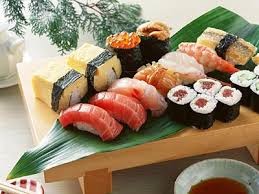
  • Sushi was originally useed as a way of preserving fish in fermented rice. The fish used to be mainly fresh water fish, from lakes or rivers, so only the few people that lived alongside these rivers used to partake in preserving fish. But the custom spread, and soon enough almost all of Japan were partaking this practice. It was not until the 15th to the 19th Century that sushi was then wrapped in Sashimi. 
  • When the ports were finally open to the Western world, their Emperor finally allowed the custom of eating meat in public. And although their natural food may seem blend and tasteless as its just vegetables, it still has been a major influence to most of our Western food. 


Monday, 19 May 2014

Textiles in the Japanese world


  • Up until the 1600's, the townsfolk of Japan wore hemp clothing which was locally grown. Then Japan imported raw cotton from China and began to grow their own cotton farms in the warmer areas of Japan where cultivation works best. Spinning your own cotton became a very common thing to do with the house wives of rural Japan. In relation to the West, Japan began their milling factories much later, but the woman of Japan preferred to spin their own clothing just the same. 


  • In the Northern Isles of Japan, the women recylcled the cotton fabrics by putting layer upon layer and using a Sashiko stitch to hold the fabrics in place. Therefore the garments produced were normally for colder reigons and the people welcomed the softness of the cotton. But other than garment, the women also produced textiled based decor four their houses. 

     Source:

Kimonoboy's. A short history on Japanese Textiles  [online] Available at: <http://www.kimonoboy.com/short_history.html> [Accessed 19th may 2014].

Japanese Vases

Typical Japanese Vase

  • Amongst other Japanese decor, the vase is the one most found in  households. They vary in shape, size and style. But they all seem to have that one aspect that bounds them to the style of the eighteenth century. Although, the Japanese vase seems to have been an inspiration to the Victorian style of Vases.

  • Most Japanese vases have pictures of birds or landscapes (much like most of their indoor decor) Others have elaborate scenes with people and landscapes. Another common thing that i noticed was that most vases come in sets of two. And although these two vases are of a set, they might not be identical. But still they have the same colour scheme. Soft blues are usually found in vases, as well as browns and light greens. 
Japanese vase with people and landscapes

Japanese Vase with bright blue.
  • Compared to the Victorian vases, the Asians have a more simpler design to the vase itself, whilst the Victorian vases are more elaborate, with handles and such. Also, Japanese vases are much larger in size compared to the Victorian vases.
    Typical victorian Vase


Sources:
Images were found from google.

The ancient art of Woodblock Prints


  • The traditional art of Woodblock prints began in the eight century, but was then known world wide in the eighteenth century when trade opened for Japan. 

  • To make the blocks, the artists use a purposely natural wood, cherry, that can withstand moist conditions and prevent worpage. 
  • The idea is to carve out a series of reliefs upon the wood which would then have the wet pigments used to press out the mass of colour which is a feature key in their prints. The blocks would vary from style of high relief to low relief, including the aspects of colour or outline. Usually the blocks of wood that would be used to give the colour to the wood would usually have a loose grain and softer wood so it absorbs more of the pigment. 


  • The paper use to preserve these beautiful prints are also important. The traditional paper used is called Mulberry which is important because the paper becomes flexible, absorbent, and light weight. Genuine block printswould show the chain-lines of the paper.


    chisels used to create the engravings on the wood

    brushes used to add pigment to the blocks

    example of wooden block print with relief.
Sources:


John Fiorillo 1999. How is a Japanese print made?  [online] Available at: <http://viewingjapaneseprints.net/texts/topictexts/faq/faq_making_a_print.html> [Accessed 19th May 2014].


The inside world of a Geisha

 Geisha
  • The way the Geisha practice their arts has been a secret until the early 2000's when author Arthur Golden wrote his novel "Memoires of a Geisha"
  • They are not entirely prostitutes as some might think; "Geisha" means art in Japanese and to become a Geisha one must endure a series of years of intense studies from the art of make-up, dancing, music and literature to the tea ceremonies that take place in typical Japanese banquets. 
  • They undertake lessons on how to be of a good company to men. This does not mean that they are required to sleep with their customers; merely entertain them by dance and actual companionship.


  • A Geisha represents elegance and beauty. Their Kimonos are their most prized possessions, which are very expensive and are worn according to season. The Maiko (the Geisha in-training) has a different style than that of her older sister, the Geiko (aka Geisha). The Maiko has to wear a lot of layers of bright coloured Kimonos with long sleeves. Their darari obi is very long and thick, this gives her a child-like appearance. She also has to wear Okobo (which are more like clogs than sandals). In their hair they wear fancy Kanzashi. Their make-up consists of white Bintsuke-abura but they leave a small layer of their skin still showing around their face and nape. This enhances the mask-like effect and also creates a sense of revealing nudity. 
  • The proper Geisha, or Geiko, on the other hand wear much simpler kimonos with a distinctive plain white collar underneath. Their Drum changes to a Taiko Musubi, which is like a small box at their back. The purpose of this is so that they have back support when they would be seated. Their sleeves are much shorter and they now wear the Zori (sandals.) Their hair is also much simpler and they don't carry much adornment. 
revealing the skin upon the nape
Geiko Geisha


Maiko Geisha


  • But like many of Japanese culture, the Geisha are dying out. The younger men pre-fare the company of hostesses or normal women. But their mysterious culture of rituals and silence still finds its way to intrigue the outside Western world. So will the Geisha become extinct? Or will her beautiful culture live on? 


Sources:


Discover Japan, 2013. The secret lives of Geisha [Part 1]  [video online] Available at: <https://www.youtube.com/watch?v=ZjhBEgwFP2M> [Accessed 18th May 2014].


Tuesday, 13 May 2014

Fauvism - Art

Like Impressionism, Fauvism expressed their paintings by using bright colours straight from the tube and using thick and repeated brush strokes. It is common to find their work usually with the canvas on which they painted still showing. Their use of colour is what strikes out the most, but what exactly is Fauvism?


"The Open Window"

Henri Matisse (1869-1954)

  • "The open Window" (1905)- is an example of how his work had changed when he went to the South of France. His surroundings were so bright and colourful that they inspired him to paint with thick brush strokes and bright coloured paint. He uses the paint to give a hint of what the object actually is, but you can still tell that the soft purple line over the horizon could be some sort of landscape. It's bright hues on the doors and walls give an almost feminine feel. There is also a very calm atmosphere which is picked up by the swaying notion of the boats; almost as if Matisse finally found some peace and quiet in his life. 


    La Joie de Vivre
  • "La Joie de Vivre" 1906- (the joy of life). In this painting Matisse enhanced his approach of the bright colours. But there still is a sense of unrealistic features like the skin colour and of the yellow ground. The trees are very peculiar; they are very curvy and almost mimic the female figure, giving a sense of sensuality to nature. There also seems to be a sense of music within the painting, depicted by the two figures playing on folk flutes and the group of dancers dancing in a circle towards the center of the painting. This shows how life mustn't always be taken seriously and one should take one's time to relax, rewind and enjoy nature. 


    The Dance
  • "The Dance" (1910)- here we find the repeated concept of dancing from La Joie De Vivre where the focus is just on five naked women dancing about in a circle. This painting has a sense of primitive simplicity where the women do not bother themselves with work or labor or any materialistic things, they hold each other's hands and dance about. If you notice, there is a part of the circle where one of the women fell down on her knees and cut off the connection of the circle, the severed connection looks like its caught in the moment where they're barely touching and yet it feels like in that moment of separation, they're asking you to join them and forget all you're worries. Although, what is most significant with this painting is the way Matisse handles his colours, instead of it being a very detailed painting with shadows and depth, he leaves the paint to have only one gradient so there's no blending whatsoever. This also helps to imprint the idea of simplicity. This idea could have originated from the Japnonisme Style, where colours are added in blocks. 

So here's my tribute to Fauvism- I painted this piece keeping in mind the techniques of fauvism, although I happened to use more paint and covered the whole paper, I played around with the colours, giving the walls a blue that isn't there. It's not at Matisse's level, but it's inspired from his work.




Saturday, 10 May 2014

Animation Design


Have you ever wondered how the world's most famous films began? Or what lead films such as Frozen to their amazing capacity? As always, our story begins in the past...

Lady & the Tramp

  • This Disney Classic came out mid June 1955. The story is of a well known forbidden romance between two statuses in society. The high and purebred Springer Spaniel, Lady, and the low mutt, Tramp. The story was written by Ward Greene, edited to Disney's approval. Walt Disney himself commented that he had actually given his wife a puppy in a hat box as an apology to her for forgetting an important dinner, he had told her that someday he would want to put that scene in a film, and his dreams were fulfilled. 
  • Originally the film was meant to be viewed as a CinemaScope, which is a sort of old fashioned Imax which gave a more panoramic look, but it aroused lots of difficulties as the animators had trouble focusing on only one character at a time, plus not all the cinema's around the world had the advantage of the CinemaScope. Thus the company saved on money by just making one normal animated film. 
  • As was custom of the films of that era, the credits were shown at the beginning. Something that nowadays seems too bizarre and time consuming. The film is set in the 19th Century where gas lamps are in use and also the beginning of cars. The architecture of the house is typically Victorian American, with its exaggerated white banisters and adorned arches. It also has a Neo-Gothic feel to it, with the pointed arch, but where usually such designs were mostly found on stone, these houses are made of wood, so it has it's own unique touch. From outside to inside, the house's decor screams Art-Nouveau, with the floral wallpaper and textile decorations all over the house. 
  • On another note, the character design is also varied. There's the Asian Siamese cats Si and Am, the two Italian chefs from Tony's, the Scottish Schnauzer Jock and the comments Tramp passes on about certain neighbors.


Legend of the Guardians: The owls of Ga'hoole 

  • This animated film is an epic battle between two owl clans. When Soren peruses his dreams to find the Guardians in order to warn them of the Pure Ones' (the bad guys) wrong doings in moon blinking the owlets they steal into slavery.  The story then leads to an epic battle of tragedy and loss. 
  • The film was based on the books written by Kathryn Lasky and was released in 2006 but actually came out in 2010, making that a four to five year long process. It is CGI animated in a way that all the details stand out, from their eyes and feathers to their gorgeous landscapes. It took over five hundred artists to produce such a work.
  • The visual concepts of the landscapes were designed in a way that we automatically relate to something either Celtic or Elvish, that no mundane human has ever been to. This sort of design can be seen clearly through the armor the owls wear when preparing for battle. 


Sources-


"Demosthenes", 2011. Disney's Lady and the Tramp. Reel History  [blog] 13 July. Available at: <http://norlinreelhistory.blogspot.com/2011/07/disneys-lady-and-tramp.html> [Accessed 7th May 2014].


    AnimalLogic. Legend of the Guardians: the owls of Ga'Hoole. [online] Available at: <http://www.animallogic.com/Studios/Work/Legend-Of-The-Guardians- the-Owls-of-Ga-hoole> [Accessed 7th May 2014]